Boost Math Skills? Teacher-Approved Games That Actually Work
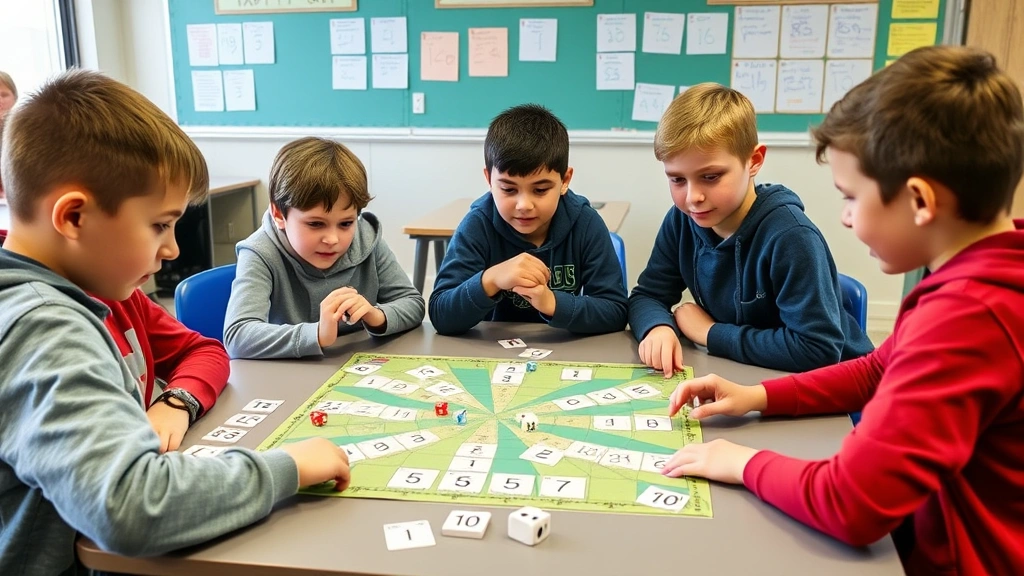
Mathematics anxiety affects millions of students worldwide, yet one of the most effective solutions sits right in front of us: games. Research from the American Psychological Association demonstrates that game-based learning reduces math anxiety while simultaneously improving computational fluency and problem-solving abilities. Teachers across the globe have discovered that when students engage with mathematical concepts through play, retention rates skyrocket and classroom engagement transforms dramatically.
The beauty of game-based math instruction lies in its ability to make abstract concepts tangible and fun. Whether you’re an educator seeking fresh classroom strategies, a parent supporting your child’s learning journey, or a student looking to strengthen your mathematical foundation, understanding how to leverage games for math mastery opens doors to genuine academic growth. This comprehensive guide explores teacher-approved games that have proven effective in diverse educational settings.

Why Games Transform Math Learning
Games activate multiple learning pathways simultaneously. When students play math games, they engage cognitive processes that traditional worksheets simply cannot stimulate. Learning science research confirms that spaced repetition combined with active engagement produces superior long-term retention compared to massed practice.
The psychological benefits extend beyond academic performance. Games create psychological safety—students willing to take risks and make mistakes in game contexts often transfer this confidence to formal assessments. Additionally, games provide immediate feedback, allowing learners to adjust strategies in real-time rather than waiting for graded assignments.
For teachers, games offer remarkable classroom management advantages. When students are genuinely engaged in meaningful mathematical play, behavioral issues diminish substantially. The competitive or collaborative nature of games channels student energy productively.

Classroom Games for Elementary Math
Number Bond Bingo helps younger students develop number sense and understand part-whole relationships. Teachers create bingo cards featuring various decompositions of target numbers. As numbers are called, students identify which cards contain related bonds, building fluency with fundamental addition and subtraction facts.
Dice Games and Variations offer tremendous flexibility for elementary instruction. Simple games like “Race to 100” require students to roll dice, multiply or add the results, and track cumulative scores. These games naturally differentiate—faster learners can play with larger numbers or more complex operations while struggling students practice foundational skills.
Fraction Games address one of elementary mathematics’ greatest challenges. Games like “Fraction Match” where students pair equivalent fractions, or “Fraction War” using fraction cards, make abstract concepts concrete and memorable. Research from the National Council of Teachers of Mathematics emphasizes that fraction understanding developed through games correlates strongly with later algebra success.
Place Value Games solidify understanding of our base-ten system. Games like “Place Value Poker” where students construct the largest possible numbers from randomly drawn digits, or “Place Value Capture” where players strategically place digits to create target numbers, make positional notation engaging and intuitive.
When exploring local educational resources, teachers in areas near Old Bridge Golf Course communities often find that outdoor field days incorporating math games provide excellent enrichment opportunities for elementary learners.
Middle School Math Games That Engage
Middle school students crave challenge and social interaction—games perfectly satisfy both needs. Algebra Tile Games transform abstract algebraic thinking into manipulative-based learning. Students physically arrange tiles to solve equations, making the concept of maintaining balance across an equals sign viscerally clear.
Integer Games help students master positive and negative numbers through competitive play. Games like “Integer Football” where students gain or lose yards based on mathematical operations, or “Number Line Hop” requiring strategic positioning, make integer concepts intuitive rather than abstract.
Probability and Statistics Games develop crucial mathematical reasoning. Games involving dice, cards, and prediction create natural contexts for discussing theoretical versus experimental probability. Students develop statistical thinking while enjoying genuine entertainment.
Geometry Construction Games build spatial reasoning essential for higher mathematics. Games where students construct specific shapes under time pressure, or compete to identify properties of various geometric figures, strengthen geometric intuition dramatically.
Ratios and Proportions Games address another critical middle school concept. Games like “Ratio Mixing” where students must combine ingredients in specific proportions to achieve targets, or “Scale Model Construction” challenges, make proportional reasoning concrete and applicable.
Teachers in communities near Heron Glen Golf Course areas report success incorporating outdoor measurement games that naturally involve ratios and proportional relationships.
High School Strategy Games
High school mathematics demands sophisticated thinking—games must match this complexity. Strategy Card Games like Set and Uno variants modified for algebraic expressions develop pattern recognition and strategic thinking. Students analyze multiple pathways to solutions, evaluating trade-offs and consequences.
Programming and Algorithm Games introduce computational thinking through engaging contexts. Games requiring students to write algorithms to solve puzzles, or competing to optimize code efficiency, develop mathematical logic in authentic ways.
Game Theory and Decision-Making Games introduce students to genuine mathematical applications. Games like prisoner’s dilemma, auction games, or negotiation scenarios teach game-theoretic concepts while developing critical reasoning about strategic interaction.
Calculus Concept Games make limits, derivatives, and integrals less abstract. Games where students approximate area under curves, or compete to identify functions from derivative information, strengthen conceptual understanding of calculus fundamentals.
Competition-Based Mathematics Games like Math Kangaroo, MATHCOUNTS, and similar competitions engage motivated students. These games develop problem-solving under pressure while providing authentic achievement opportunities.
Students in Hudson Hills Golf Course adjacent communities benefit from mathematics clubs that organize competitive math gaming tournaments.
Digital Platforms and Apps
Desmos Activities provide teacher-created, interactive mathematical explorations. These platform-agnostic games let students experiment with functions, geometry, and statistics in visually engaging environments. Teachers can monitor student thinking in real-time, adjusting instruction based on observed understanding.
Prodigy Math Game adapts difficulty based on student performance, offering personalized math practice disguised as fantasy adventure. Students battle creatures by answering math questions, creating natural motivation for engagement.
Mathway and Photomath Competitions encourage students to solve problems efficiently, developing speed and accuracy. When students compete to solve problems faster than peers, engagement increases substantially.
GeoGebra Applets allow dynamic exploration of geometric and algebraic concepts. Students manipulate parameters and observe how graphs and shapes transform, developing deep conceptual understanding through discovery.
Kahoot! and Quizizz gamify formative assessment. Real-time competitive quizzes maintain engagement while providing teachers valuable data about student understanding. The game mechanics—leaderboards, streaks, power-ups—drive participation from typically disengaged students.
Educators interested in Online Courses for Entrepreneurship often incorporate game-based learning principles to teach business mathematics.
Implementing Games Successfully
Clear Learning Objectives ensure games serve educational purposes rather than becoming mere entertainment. Before introducing any game, identify specific mathematical concepts or skills you’re targeting. Ask: What mathematical thinking does this game develop? How does it connect to my curriculum standards?
Explicit Rules and Practice Rounds prevent confusion and frustration. Allocate time for students to understand rules completely before competitive play begins. Allowing practice rounds without scoring stakes helps students focus on learning rules rather than winning.
Balanced Competition and Collaboration matters tremendously. While competitive games motivate many students, collaborative games reduce anxiety for others. Offering both game types throughout your curriculum acknowledges diverse learner preferences.
Reflection and Connection transform games from entertainment into genuine learning. After playing, facilitate discussions connecting game strategies to mathematical concepts. Ask students to explain why certain strategies worked, how game mathematics relates to standard algorithms, and what they discovered through play.
Differentiation Through Game Variation allows all learners to access appropriate challenge levels. Modify game rules, number ranges, time limits, or complexity based on student needs. Advanced learners might play with larger numbers or additional constraints while struggling students work with foundational content.
Regular Integration rather than occasional use produces optimal results. When games appear regularly in your instruction, students develop game literacy and focus more on mathematical content than learning new game mechanics. Consider dedicating specific class periods to game-based instruction.
Teachers near Sherrill Park Golf Course communities have developed outdoor mathematical games incorporating local geography, creating authentic connections between school mathematics and student environments.
Assessment Through Games provides authentic formative assessment data. Observe which students employ efficient strategies, who struggles with specific concepts, and how students respond to challenge. This information guides future instruction more accurately than traditional quizzes.
Research from Edutopia documents that teachers who systematically implement game-based learning report increased student engagement, improved mathematical reasoning, and stronger classroom communities.
FAQ
How much class time should I dedicate to math games?
Research suggests 15-20% of instructional time spent on game-based learning produces optimal results. This translates to approximately one class period weekly in typical settings. Some teachers integrate games into warm-ups or station rotations, reducing dedicated time while maintaining benefits.
Do math games work for all grade levels?
Yes, though game complexity must match developmental levels. Elementary students enjoy simpler games with immediate feedback, while high school students appreciate strategy-rich games involving multiple moves and consequences. Adjusting game complexity ensures appropriateness across grade spans.
What if students find games too easy or too difficult?
Differentiation is essential. Offer multiple game variations simultaneously—advanced versions for quick learners, foundational versions for struggling students. Allowing student choice increases engagement across ability levels.
How do I manage classroom behavior during games?
Clear expectations, established routines, and meaningful consequences maintain order. Teach game behavior expectations explicitly. Consider using games as rewards for strong classroom management, creating positive associations.
Can games replace traditional practice?
Games complement rather than replace traditional instruction. They develop conceptual understanding and engagement but shouldn’t eliminate purposeful practice entirely. Combine games with targeted practice for comprehensive instruction.
How do I assess learning through games?
Observe student strategies, listen to mathematical reasoning, and track performance patterns. Use game data informally to guide instruction. Combine game observation with traditional assessments for complete understanding of student learning.


