
Master Ninja Warrior Skills: Expert Guide to Obstacle Course Training
Ninja Warrior obstacle courses have transformed from niche athletic pursuits into mainstream fitness phenomena. Whether you’re training for competition or personal achievement, mastering these skills requires understanding biomechanics, progressive training methodology, and mental resilience. This comprehensive guide explores evidence-based approaches to developing elite-level ninja warrior capabilities.
The rise of obstacle course racing and ninja warrior competitions has sparked significant interest in athletic training science. These events demand unique combinations of strength, agility, coordination, and problem-solving abilities. Success depends not merely on raw power but on intelligent programming, consistent practice, and strategic skill development.

Understanding Ninja Warrior Obstacle Fundamentals
Ninja warrior obstacle courses present diverse physical challenges requiring technical proficiency and adaptability. Understanding the fundamental categories of obstacles helps athletes prioritize training focus. Research from the American College of Sports Medicine indicates that sport-specific training produces superior results compared to generic fitness approaches.
The primary obstacle categories include traversal challenges (moving horizontally across obstacles), vertical climbs (ascending walls and ropes), balance elements (narrow beams and unstable surfaces), and dynamic movements (jumping, swinging, and explosive transitions). Each category demands distinct neuromuscular adaptations and technical skills.
Traversal obstacles like the salmon ladder, warped wall, and pipe dreams require exceptional grip strength, core stability, and body awareness. Athletes must develop proprioceptive sensitivity—the ability to sense body position in space without visual confirmation. This skill develops through consistent practice on varied surfaces and deliberate exposure to unstable conditions.
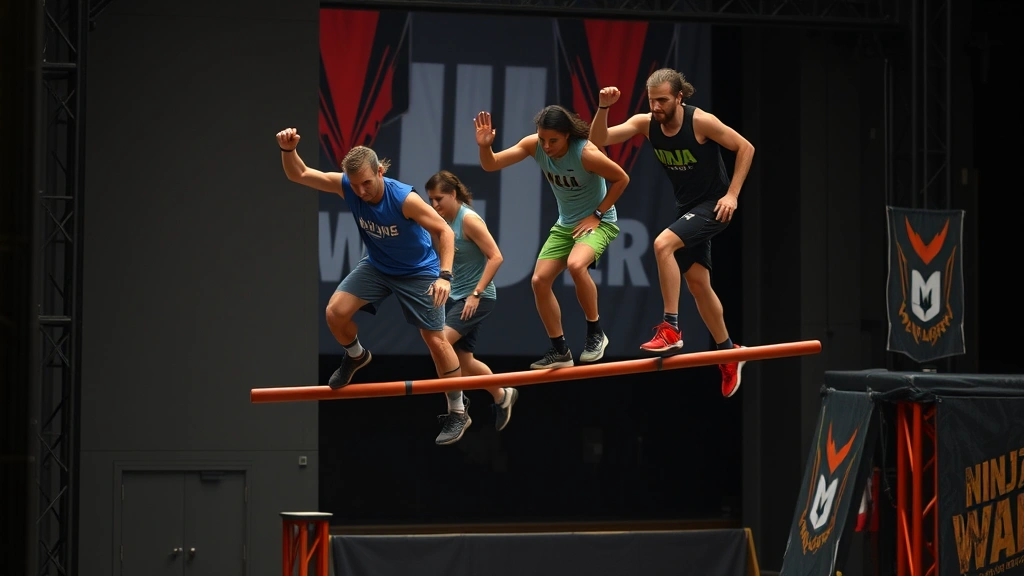
Balance-based obstacles demand exceptional proprioceptive development and mental focus. The narrow passage, rolling log, and unstable plank obstacles force athletes to maintain equilibrium while fatigued. Training balance under fatigue conditions produces superior real-world performance compared to training balance in fresh states.
Essential Physical Conditioning Requirements
Elite ninja warrior athletes demonstrate exceptional levels of functional strength, muscular endurance, and cardiovascular capacity. A comprehensive conditioning program must address all three components systematically.
Grip strength represents the foundation of ninja warrior success. Athletes require grip endurance exceeding 60 seconds on demanding obstacles. Progressive training involves dead hangs, farmer carries, and grip-specific implements. Research demonstrates that grip strength correlates strongly with overall obstacle course performance.
Core strength extends beyond traditional abdominal work. The core encompasses the entire musculature stabilizing the spine and pelvis—including deep transverse abdominis, multifidus, diaphragm, and pelvic floor muscles. Effective core training incorporates anti-rotation exercises, loaded carries, and dynamic stability work. Planks, pallof presses, and dead bugs develop foundational stability necessary for complex movements.
Upper body pulling strength proves essential for traversal obstacles and rope climbs. Lat pulldowns, pull-ups, and assisted pull-ups build pulling capacity. Progressive training advances from assisted variations toward single-arm pulling movements. Athletes should target 15-20 consecutive pull-ups as a baseline standard.
Leg strength and power enable explosive jumping and climbing movements. Squats, lunges, and single-leg variations build lower body strength. Plyometric training—including box jumps, broad jumps, and bounding exercises—develops the explosive power necessary for dynamic transitions between obstacles.
Cardiovascular conditioning must reflect the demands of obstacle course racing. Rather than steady-state endurance training, high-intensity interval training (HIIT) better prepares athletes for the variable intensity demands of navigating multiple obstacles. Training sessions should incorporate work-to-rest ratios reflecting actual competition demands.
Progressive Training Methodology
Effective ninja warrior training follows systematic progression from foundational skills toward advanced techniques. This structured approach minimizes injury risk while maximizing adaptation and performance gains.
Phase one: Foundation building establishes baseline strength and movement quality. This phase emphasizes proper exercise technique, basic grip development, and introductory balance work. Duration typically spans 4-6 weeks, allowing neuromuscular adaptation to training stimulus.
Phase two: Skill acquisition introduces obstacle-specific techniques on modified versions. Athletes practice salmon ladder progressions, wall run fundamentals, and rope climbing basics. This phase emphasizes technical proficiency over intensity or speed. Training volume increases while intensity remains moderate.
Phase three: Integration and complexity combines multiple skills into obstacle sequences. Athletes practice transitioning between obstacles, managing fatigue while maintaining technical proficiency, and problem-solving novel obstacle configurations. This phase develops the adaptability essential for competition success.
Phase four: competition preparation simulates actual competition conditions. Athletes complete full obstacle course runs, practice pacing strategies, and develop mental resilience under competition stress. Training incorporates obstacles in varied orders, environmental conditions, and fatigue states.
Progressive overload—systematically increasing training demands—drives continued improvement. Progressions include increasing repetitions, reducing rest periods, adding resistance, increasing movement speed, or introducing instability. Effective programming balances progression with recovery to prevent overtraining and injury.
Deload weeks occurring every 4-5 weeks reduce training volume by 40-50%, allowing physiological recovery and adaptation consolidation. These strategic rest periods prevent cumulative fatigue and maintain long-term training consistency.
Mental Preparation and Problem-Solving
Ninja warrior success depends substantially on mental factors including focus, problem-solving ability, and resilience under pressure. Psychological training receives less attention than physical conditioning but proves equally important for elite performance.
Visualization training—mentally rehearsing successful obstacle navigation—activates similar neural pathways as physical practice. Athletes should spend 10-15 minutes daily visualizing themselves executing obstacles flawlessly, managing obstacles efficiently, and overcoming challenges successfully. Research from sports psychology demonstrates that visualization significantly improves actual performance outcomes.
Problem-solving training develops the cognitive flexibility necessary for novel obstacles. Athletes should practice analyzing obstacles quickly, identifying multiple solution approaches, and selecting optimal strategies based on their abilities. Exposure to varied obstacle designs and configurations builds this cognitive flexibility.
Stress inoculation training—deliberately practicing under stressful conditions—reduces anxiety during competition. Athletes should complete full obstacle course runs with time pressure, in unfamiliar environments, and while fatigued. This training normalizes competition stress and maintains technical execution under pressure.
Goal-setting frameworks provide motivation and direction. Effective goals follow SMART criteria: Specific (precisely defined), Measurable (quantifiable), Achievable (realistic), Relevant (aligned with overall objectives), and Time-bound (with completion deadlines). Short-term process goals (specific training targets) prove more motivating than distant outcome goals.
Sport-Specific Skill Development
Mastering individual obstacles requires dedicated technique training. Each obstacle presents unique challenges demanding specific skill development.
Salmon ladder training emphasizes explosive hip drive and grip security. Progressive training begins with assisted versions or lower heights, advancing toward full salmon ladder execution. Athletes practice explosive hip extension, synchronized hand movements, and efficient foot placement.
Warped wall success depends on explosive leg power, arm strength, and technique efficiency. Training includes wall runs on standard walls, practicing plant and push-off mechanics, and developing the explosive power necessary for rapid ascent. Many athletes benefit from practicing on actual curved surfaces rather than flat walls.
Rope climb proficiency requires exceptional grip endurance, core strength, and climbing technique. Progressive training includes rope hangs, rope pulls, and climb progressions. Athletes should practice both standard rope climbs and variations like rope climbs with speed requirements.
Traverse obstacles demand exceptional grip endurance and shoulder stability. Training includes various gripping implements—monkey bars, pipe hangs, and rope traversals. Athletes practice maintaining grip security while fatigued and managing shoulder fatigue across extended periods.
Balance obstacles require proprioceptive development and mental focus. Training includes standing on unstable surfaces, walking narrow beams, and practicing balance movements while fatigued. Progressive training increases difficulty by reducing surface stability or introducing dynamic elements.
Jumping obstacles demand explosive power, precise distance calculation, and confidence. Training includes broad jumps, box jumps, and practicing jumping under fatigue. Athletes benefit from practicing jumps between obstacles at varying distances to develop distance judgment.
Nutrition and Recovery Strategies
Optimal nutrition supports training adaptations and competition performance. Athletes engaged in intensive ninja warrior training require strategic nutritional planning.
Protein intake supports muscle development and recovery. Athletes should consume 1.6-2.2 grams of protein per kilogram of body weight daily, distributed across multiple meals. Timing protein consumption around training sessions optimizes muscle protein synthesis.
Carbohydrate fueling provides energy for high-intensity training. Consumption timing varies based on training intensity and duration—light meals 2-3 hours before training, or quick carbohydrates 30-60 minutes before. Post-training carbohydrates replenish depleted glycogen stores.
Hydration strategies maintain performance and support recovery. Athletes should drink sufficient fluids to maintain body weight, consuming water throughout training and competition. Electrolyte replacement becomes important during extended training sessions lasting over 90 minutes.
Sleep optimization proves essential for training adaptation. Elite athletes require 8-10 hours nightly, with consistent sleep schedules supporting optimal recovery. Sleep deprivation impairs motor learning, decision-making, and injury risk management—all critical for ninja warrior success.
Recovery modalities including foam rolling, stretching, and active recovery sessions facilitate adaptation between training sessions. Recovery days should include light activity promoting blood flow without significant stress. When you’re training like competitors at elite athletic facilities, recovery becomes equally important as training intensity.
Common Mistakes and Solutions
Analyzing common training errors helps athletes avoid setbacks and accelerate progress. Experience from successful ninja warrior athletes reveals consistent patterns in effective versus ineffective approaches.
Mistake: Neglecting grip strength development leads to premature obstacle failure. Solution: Dedicate 10-15 minutes daily to grip-specific training including dead hangs, farmer carries, and grip implements. Systematic grip progression prevents plateau and ensures this critical foundation receives adequate attention.
Mistake: Insufficient balance training results in balance obstacle failures despite adequate strength. Solution: Incorporate 15-20 minutes weekly of dedicated balance work on progressively unstable surfaces. Train balance when fatigued to simulate competition conditions.
Mistake: Inadequate technique focus leads to inefficient movement patterns limiting performance. Solution: Record movement videos, analyze technique carefully, and practice movements at reduced speed before increasing intensity. Technique proficiency precedes speed and intensity development.
Mistake: Overtraining without adequate recovery causes fatigue accumulation, performance plateaus, and injury. Solution: Implement structured deload weeks, prioritize sleep, and monitor training readiness through subjective assessments and objective metrics like resting heart rate.
Mistake: Limited obstacle exposure prevents adaptation to diverse challenges. Solution: Train on varied obstacles in different configurations. Visit training facilities offering multiple obstacle types, or construct DIY obstacles replicating competition designs. Similar dedication applies whether training at specialized training venues or improvised spaces.
Mistake: Neglecting mental preparation limits performance under pressure despite strong physical conditioning. Solution: Incorporate daily visualization, stress inoculation training, and competition simulation. Mental skills require deliberate training identical to physical skill development.
Mistake: Inadequate nutrition planning compromises training recovery and performance. Solution: Plan meals around training sessions, track protein intake, maintain hydration consistency, and prioritize sleep. Nutrition supports training adaptations—neglecting nutrition undermines physical training benefits.
Advanced Training Considerations
Elite-level ninja warrior athletes benefit from advanced training strategies developed through sports science research. These approaches represent refinements building upon foundational principles.
Periodization strategies vary training demands across weeks and months, optimizing adaptation while preventing plateaus. Periodized training produces superior long-term outcomes compared to random variation. Effective periodization aligns training phases with competition schedules.
Conjugate periodization develops multiple qualities simultaneously—strength, power, and endurance—within each training week. This approach suits ninja warrior training’s diverse demands. Rather than sequential phases, athletes train different qualities on different days, allowing adequate recovery between stimulus types.
Autoregulation adjusts training intensity based on daily readiness rather than predetermined plans. Athletes assess readiness through subjective factors (mood, motivation, sleep quality) and objective measures (heart rate variability, grip strength testing). This approach prevents excessive fatigue while capitalizing on high-readiness days.
Advanced athletes benefit from altitude training improving aerobic capacity, though access limitations restrict this approach. Sea-level training with adequate recovery provides more practical benefits for most athletes.
Strength periodization systematically varies rep ranges and intensity. Phases emphasizing heavy loads with low reps build maximum strength. Phases emphasizing moderate loads with higher reps build strength endurance. Appropriate variation prevents adaptation plateaus while developing comprehensive strength qualities.
Training at facilities like premier athletic training centers provides access to specialized equipment and expert coaching, though dedicated athletes achieve substantial results with creative home training setups.
Competition Strategy and Pacing
Successful competition performance requires strategic planning beyond physical preparation. Elite athletes develop sophisticated competition strategies.
Course reconnaissance allows athletes to preview obstacles, identify optimal approaches, and plan pacing strategies. Video analysis of competition courses reveals obstacle sequences, transitions, and potential bottlenecks. Mental rehearsal of planned strategies reduces decision-making demands during competition.
Pacing strategy balances speed with sustainability. Excessive early speed often results in premature fatigue and poor later performance. Effective pacing distributes effort across the entire course, maintaining consistent intensity while managing fatigue accumulation.
Obstacle-specific strategies vary by individual strengths and weaknesses. Athletes excel at different obstacles based on their physical attributes and experience. Strategic approaches might emphasize speed on favorable obstacles while accepting slightly slower times on challenging obstacles.
Contingency planning addresses potential obstacles or challenges. Athletes develop backup approaches for obstacles where their primary strategy might fail. Mental preparation includes visualizing overcoming obstacles despite fatigue or unexpected difficulties.
Competitive experience at venues similar to established training locations develops confidence and practical experience informing competition strategies.
Building Sustainable Training Culture
Long-term ninja warrior success depends on sustainable training approaches preventing burnout and maintaining motivation across years. Building effective training culture supports consistent progress.
Community engagement provides motivation, accountability, and shared learning. Training with peers, joining local ninja warrior groups, and participating in community challenges maintains engagement. Social support predicts training adherence and long-term success.
Coach guidance provides expertise, objective feedback, and personalized programming. Experienced coaches identify movement limitations, suggest appropriate progressions, and prevent common errors. Coaching investment accelerates progress while reducing injury risk.
Facility access enables consistent training on diverse obstacles. Dedicated ninja warrior gyms provide comprehensive obstacle collections, expert coaching, and community support. Home training requires creativity and DIY construction but remains viable for committed athletes.
Motivation maintenance requires varied approaches preventing monotony. Regularly introducing new obstacles, training partners, or training locations maintains engagement. Setting diverse goals—competition targets, personal records, or skill achievements—provides ongoing motivation.
Injury prevention prioritizes long-term health over short-term performance. Appropriate progression, adequate recovery, and movement quality prevent many injuries. When injuries occur, appropriate rehabilitation and modified training maintain progress while healing.
Whether training at specialized facilities or improvised spaces like those near accessible public venues, consistent training commitment drives progress.
FAQ
How long does it take to master ninja warrior skills?
Timeline varies substantially based on starting fitness level, training frequency, and prior athletic experience. Most athletes require 12-24 months of consistent training to complete intermediate courses, and 24-36 months to achieve elite competition levels. Accelerated progress requires 4-5 training sessions weekly with expert coaching.
What’s the minimum age for ninja warrior training?
Children as young as 6-7 can safely participate in age-appropriate ninja warrior training emphasizing movement fundamentals, balance, and fun. Progressive training advances as children develop physically and cognitively. Adolescents (13+) can pursue more intensive training approaching adult protocols with appropriate modifications.
Can I train at home without expensive equipment?
Yes. Effective home training requires creativity but minimal investment. DIY pull-up bars, rope attachments to tree branches, and constructed balance beams enable comprehensive training. Many successful athletes trained substantially at home before accessing formal facilities.
What injuries are most common in ninja warrior training?
Grip-related injuries (finger strains, palm blisters), shoulder impingement, and wrist strain occur most frequently. Proper progression, appropriate recovery, and technique emphasis prevent most injuries. Immediate attention to minor discomfort prevents progression toward serious injury.
How do I know if I’m overtraining?
Overtraining indicators include persistent fatigue despite adequate sleep, elevated resting heart rate, decreased performance despite continued training, mood disturbances, and increased illness frequency. Implementing deload weeks and monitoring readiness prevents overtraining.
Should I specialize in certain obstacles or train comprehensively?
Comprehensive training across all obstacle types develops versatile athletes capable of handling diverse competitions. However, emphasizing strengths while addressing weaknesses provides practical balance. Most athletes benefit from balanced development with slight emphasis on strength areas.
What role does flexibility play in ninja warrior training?
Flexibility supports movement quality and injury prevention, though excessive flexibility offers limited direct benefit. Dynamic stretching before training and static stretching after training maintain functional mobility. Yoga or dedicated mobility work complements primary training.
How important is nutrition for ninja warrior success?
Nutrition profoundly impacts training recovery, adaptation, and performance. Proper nutrition accelerates progress while poor nutrition limits results despite excellent training. Athletes should treat nutrition as seriously as training programming.
Can beginners compete in ninja warrior events?
Most competitions offer beginner divisions specifically designed for newer athletes. Beginner courses feature shorter distances and simpler obstacles. Competing early provides valuable experience, motivation, and realistic performance assessment informing training priorities.
How do I find local ninja warrior training facilities?
Online searches for “ninja warrior gym near me” reveal local options. Many cities have dedicated facilities; smaller communities might require traveling to nearby urban areas. Online training programs provide guided training for athletes without facility access.


